What Size Generator do I need for my home?
Understanding Power Requirements for Generator Selection
When you select a backup generator for your home, you must thoroughly understand your electrical power consumption to ensure you make the right choice. Wattage represents the rate at which your household devices and systems consume electrical energy.
Each appliance in your home draws a specific amount of power, measured in watts, to operate properly. Moreover, these power demands vary dramatically—from a few watts for LED light bulbs to several thousand watts for major appliances like electric water heaters or central air conditioning systems.
To choose an appropriately sized generator, you need to calculate the total wattage of all essential items you'll power during an outage. Consequently, this assessment ensures your backup power system can handle your household's electrical load without overloading or under-performing when you need it most.
The Critical Difference:
Starting vs. Running Watts
Understanding the distinction between starting watts and running watts proves essential when sizing your generator. Many appliances—particularly those with motors or compressors—require significantly more power to start than they do to run continuously.
For instance, refrigerators, air conditioners, and well pumps all demand a surge of electricity during startup before settling into their normal operating consumption. Therefore, you must account for both values when calculating your generator requirements, or you risk selecting a system that can't handle the initial power surge.
Determining the Right Generator Size
for Your Home
Selecting an appropriately sized generator requires careful calculation of your home's electrical demands. The key is understanding that appliances typically require more power during startup than during normal operation.
Consider a standard 4-ton central air conditioning unit as an example. While it draws approximately 10,000 watts when initially starting up, its continuous operating power drops to roughly 4,000 watts once running. We recognize this startup surge, known as "inrush current," as a critical factor in generator sizing.
The same principle applies to other major household appliances. Electric ovens, washing machines, and clothes dryers all exhibit distinct power requirements that vary between startup and steady-state operation.
To properly size your generator, you should create a comprehensive inventory of all critical appliances you'll need during an outage. You must document both the starting watts (surge power) and running watts (continuous power) for each device. Subsequently, this detailed assessment will help you determine the minimum generator capacity required to maintain essential functions in your home during electrical outages.
Remember that your generator must handle the highest combination of starting and running loads that might occur simultaneously, not just the total running watts of all appliances.
Powering Your Home Electronics and Essential Circuits
As our homes become increasingly connected, understanding your power requirements has never been more critical. Today's households rely on an
expanding array of electronics—from smart TVs and computers to sophisticated home automation systems—each drawing power that adds to your total electrical load.
Before you select a generator, you should conduct a thorough inventory of your essential devices. You must calculate their combined wattage to ensure your backup power system can seamlessly maintain your lifestyle during outages. In this way, you can transform a potentially disruptive emergency into a minor inconvenience.
Right-Sizing Your Generator:
A 2000 Square Foot Home Case Study
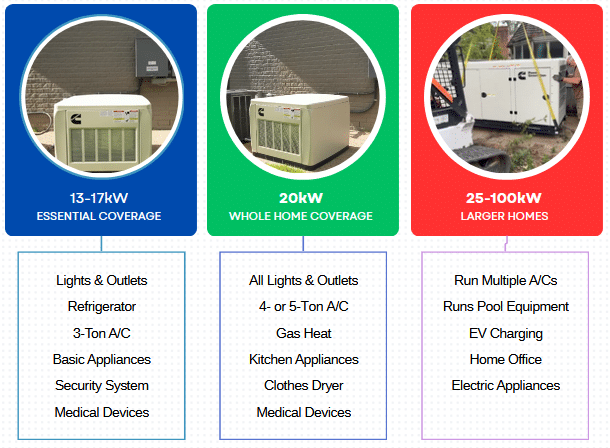
Most 2000 square foot homes in the Memphis area share similar electrical profiles. Typically, these homes feature natural gas heating systems paired with either a single 4-ton air conditioning unit or dual systems (commonly a 2-ton and 3-ton combination).
For this configuration, a 20kW Cummins air-cooled generator delivers comprehensive coverage, powering your heating and cooling systems alongside all lighting and standard outlet circuits throughout your home.
Smart Load Management for Maximum Efficiency
While your generator can handle major appliances like ovens and clothes dryers, strategic load management prevents system overload. Our "Managed Whole House" approach allows you to prioritize critical systems while temporarily shedding high-demand appliances during peak usage periods.
Through this intelligent approach, you can maximize your generator's capabilities without compromising essential comfort and safety systems. For detailed insights into comprehensive backup power solutions, explore our complete guide to Whole House Generators.
Why Professional Sizing Matters
Electrical load calculations involve complex variables that can significantly impact your generator's performance and longevity. Rather than risk under-sizing or overspending on excessive capacity, professional assessment ensures optimal system selection.
The Benchmark Electric Advantage
We begin our comprehensive approach with an on-site consultation where your dedicated sales consultant evaluates your specific power requirements. We listen to your priorities—whether you need complete whole-house coverage or prefer to focus on absolute essentials.
During this assessment, we consider your lifestyle, critical systems, and budget to develop customized recommendations that align perfectly with your needs.
Quick Online Sizing Tool
While professional consultation remains invaluable, Cummins offers a convenient online generator sizing calculator for preliminary estimates. This tool provides helpful baseline information, though you should always confirm your selection with our generator experts before you make your final investment.
Ready to secure reliable backup power for your home? Contact Benchmark Electric today for your personalized generator assessment.
Learn more about standby power: